
VIS Portfolio +38% over 3 years (11% CAGR)
An equally-weighted VIS portfolio delivered identical returns as DCA-ing into the S&P500 over the past 3 years - and will likely outperform ex-ante amidst a highly uncertain 2026.

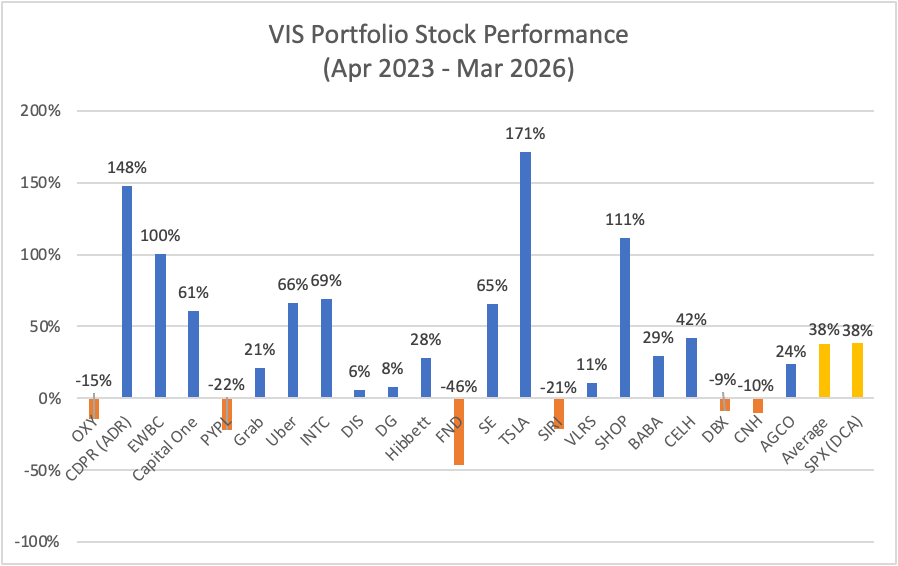
Imagine having a regular income and dollar cost averaging (DCA) into the S&P500 by investing a certain amount in it every month. Now compare that to investing in the stocks researched on this newsletter in the same manner. Doing both yields identical returns, but with lower correlation and concentration risk using the latter — compared to the former, where the Mag 7 represents 33% of the S&P500.
This article is an update post of sorts which assesses how a value investing portfolio performs amidst a truly hands-off, buy & forget, long-term hold approach. We will also be providing an update on all of the stocks mentioned in the section below.
Since I started writing about US stocks, this newsletter covered the 22 stocks shown in the chart above. They form the basis of the Value Investing Substack (VIS) portfolio — by assuming that each stock was invested in on the day of publication in an equally-weighted manner (i.e. each stock represents 4.5% of the portfolio, cash held until purchase initiated, never sell).
Each stock’s individual contribution to the portfolio is thus aggregated to derive the average performance of the wider VIS portfolio. To illustrate, take INTC for example. It gained 69% since I wrote about it, hence its assumed contribution to the VIS portfolio is 3.1% (i.e. 69% x 4.5%). Adding up the 4.5% weighted gains/losses of all 22 stocks results in an average VIS portfolio performance of 38% over 3 years — or roughly 11% CAGR.
This contrasts with DCA-ing into the S&P500 over the same period, which coincidentally also yields an identical return of 38% or 11% CAGR. As aforementioned, this assumes making an investment in the S&P500 on the same dates as the stocks in the VIS portfolio (i.e. respective date of publication).
The VIS portfolio is a value investing portfolio, hence it tends to outperform during bad times and underperform during good times. Given that 2023, 2024 and 2025 were all banner years for the S&P500, I was quite pleasantly surprised that the portfolio managed to generate identical returns as DCA-ing into the S&P would have. As we shall see below, it managed to do so despite having close to zero correlation risk between stock positions and none of the concentration risk of the Mag 7.
As we can see above, 6 out of 22 stocks posted losses while most of the remaining 16 stocks are in significantly positive territory. This implies a limited maximum drawdown of the VIS portfolio throughout the period concerned, which should result in a greater Sharpe ratio.
The limited drawdowns can be largely attributable to care taken in only selecting stocks with low valuations at the outset, putting a floor below share prices collapsing. It has also resulted in acceptable drawdowns in individual positions, even with complete fundamental duds like PYPL (-22%). The one “growth” stock in the portfolio, FND, posted the greatest drawdown (-46%).
Amidst peak valuations in a more uncertain 2026 and beyond, this proactive downside protection provided by the decision to invest only in low valuations should result in greater ex-ante performance, even if negative market environments should materialize — thus demonstrating superior portfolio risk:reward.
Individual Stock Performance Review
This section will go through each of the 22 stocks’ performance since the time of their investment — to provide more color on the risk:reward underlying each position, which should inform the risk:reward of the aggregate VIS portfolio. It also reveals the sectors involved, which demonstrates how the portfolio has nearly zero correlation between positions.
OXY (O&G, -15%): The CrownRock acquisition and the sale of OxyChem do not significantly change the big picture. OXY remains the same reliable cash flow producing asset with roughly 10% yields at current prices that it was when Buffett first started acquiring its ordinary shares.
CDPR (Gaming, +148%): The stock was pummeled at the time of writing by the bad news surrounding Cyberpunk 2077, but has re-rated due to the disappearance of said bad news and expectations normalizing over the company’s robust IP library. Valuations have gone from worried to slightly excessive as they now fully price in the expected sales of future titles. (e.g. Witcher 4 in 2027)
EWBC (Banking, +100%): Li Lu had just invested in the stock at the time of writing, and once the CRE-banking scare passed investors realized that EWBC’s portfolio had little office exposure. The China tariff scare also passed, putting EWBC in a strong position as its customers moved manufacturing to Southeast Asia and Mexico. EWBC’s fortress balance sheet benefitted as customers switched to their deposits from weaker banks after the Silicon Valley Bank debacle.
COF (Banking, +61%): Buffett had invested in the stock at the time of writing, and the bank has benefitted from the Discover acquisition by not paying interchange fees to Visa/Mastercard anymore. A stronger credit card consumer and lower interest rates also contributed to both NII expanding and deposit costs reducing.
PYPL (Financial, -22%): Operationally speaking, Paypal has pretty much failed to meet all turnaround expectations set by the new CEO at the time of writing. The latter has since resigned, and the incoming new CEO is exploring breaking up the company and selling its still-valuable assets.
GRAB (Tech, +21%): Grab continues to face fierce competition in its Southeast Asian markets, with Tiktok’s acquisition of GoTo in 2024 putting a dent in Grab’s GMV. Grab announced its first full year Adjusted EBITDA profit amidst lower incentives and promotions, and their $500m share buyback program seems to be putting a floor beneath the stock price.
UBER (Tech, +66%): Uber benefitted from being included in the S&P in early 2024 and saw growth in its mature markets of the US and the UK. The high-margin Advertising and Uber One segments continued to demonstrate growth, and Uber solved its AV problem by becoming the distribution layer for everyone else (Waymo, Aurora).
INTC (Semiconductors, +69%): Intel saw increased optimism from the entrance of a new CEO who prioritized “immediate profitability”, and from Nvidia’s investment to produce x86 chiplets for its AI and PC-grade RTX products. IFS also saw support with new investments from Softbank and rumors that Apple might use IFS for some of its high-volume chip fabrication.
DIS (Media, +6%): Disney’s Parks & Experience saw flat attendance amidst strong pricing power as DIS hiked unit prices but without seeing increased guest volume. The incoming CEO, Josh D’Amaro, is said to be a P&E guy. Disney+ reported its first profit in 2025, but Streaming profits were more than offset by continued cord cutting at Linear TV.
DG (Retail, +8%): DG’s new CEO’s successful implementation of its “Back-to-Basics” turnaround program saw an increased labor pool and SKU rationalization, which improved in-stock levels at stores. Shrink mitigation and inventory control also contributed to working capital improvements, while stores saw trade-in from a higher income consumer segment amidst high inflation and the validation of its fresh produce sales.
Hibbett (Retail, + 28%): This small-cap was first brought to my attention by John Hempton of Bronte Capital for its unique customer base, which you can read more about in my original article. The company has since been acquired by JD Sports and is no longer publicly traded.
FND (Retail, -46%): The flooring specialty retailer saw decreasing ticket and negative comps owing to persistent pressure on declining Existing Home Sales (EHS). Consensus also built-in lower growth expectations after management reduced new store openings from 30 to 20 stores in 2026. Valuations are a double-edged sword depending on which way you swing on EHS.
SE (E-commerce, +65%): SE’s valuation pulled back recently after missing guidance on Adjusted EBITDA, but has gained significantly since the time of writing on improved fundamentals at Shopee. E-commerce in Southeast Asia is maturing and take rates are improving as competitors slow on price & promotion wars. Free Fire saw a huge resurgence in Latin America and India, hitting its highest user count in 3 years.
TSLA (Auto, +171%): At the time of writing, TSLA was facing headwinds in the form of potential auto tariffs by the US & EU on cars manufactured in China. The stock continued to outperform as the Trump election win created expectations on federal AV standards, while its Energy segment surprised in 2025 by contributing to 10% of group revenues. The Auto segment saw slightly depressed performance amidst its first YoY sales decline in early 2025, as Europe and China sales face pressure from increasing EV competition.
SIRI (Media, -21%): SiriusXM reported its first negative growth of self-pay subscribers in 2025, as Gen Z and millennials increasingly turn to Spotify and other streaming platforms. Pandora also continues to bleed with plummeting ad revenue and user count. Berkshire continues to acquire its shares.
VLRS (Airline, +11%): Volaris saw increased CASM in 2025 from their partially grounded fleet due to the ongoing GTF engine inspection program. A strong dollar put pressure on operational costs while base fairs saw pressure amidst rising competition. Markets still have not priced in the Volaris-Viva merger announced in late-2025 as regulatory scrutiny increases over the creation of a near-monopoly.
SHOP (E-commerce, +111%): Shopify continued to post strong GMV growth amidst AI-directed sales funnels, improved B2B listings and sales acceleration in Europe. ShopPay also reported stronger penetration on the platform, while Shopify Capital continued to post gains.
BABA (E-commerce, +29%): Alibaba saw improved consensus expectations on its AI-first strategy, which saw the cloud revenue segment grow its margins. Taobao/Tmall also stabilized in 2025 after years of losing share to PDD.
CELH (Retail, +42%): The Alani Nu and Rockstar acquisitions supercharged revenue growth, turning CELH into an energy drink pure-play arm of Pepsi with 20% market share of the energy drink market. The introduction of Alani Nu into PepsiCo’s DSD network also improved margins at the brand, as Celsius continued to push into international markets.
DBX (Cloud, -9%): Dropbox fell recently amidst the SaaSpocalypse, but actually had a strong showing in 2025 amidst the launch of a new AI assistant (Dash) that increased ARPU and reduced user churn. The share price also benefitted from an aggressive $1.5B share buyback program.
CNH (Ag Equipment, -10%): Agriculture commodity prices continued to face pressure through 2025, resulting in CNH having to cut prices to clear an inventory glut at dealer lots. Early 2026 saw a recovery in the inventory overhang, with management also reporting that the earlier cost-cutting program initiated in 2024 was beginning to bear fruit.
AGCO (Ag Equipment, +24%): AGCO’s differentiated “retrofit” business model benefitted as high interest rates made tractor purchases prohibitively expensive to farmers experiencing an industry downcycle. The company’s premium Fendt brand was also less susceptible to inventory gluts and avoided fire sales that competitors had to enact.
As you can see, the VIS portfolio has very little correlation between its stocks and should outperform the S&P500 if 2026 happens to be a down year, as peak US valuations strongly suggest. The lack of Mag 7 concentration risk should also reduce maximum drawdown, leading to a greater Sharpe ratio as investors navigate an increasingly uncertain market.

a long wait indeed
You're back!