
Floor & Decor: Quality Compounder or Cyclical Commodity?
Presenting both the bull & bear cases for the Costco of flooring

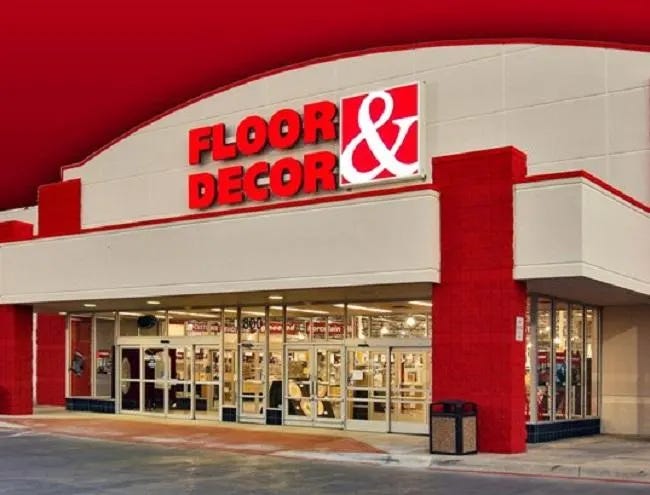
FND’s share price has fallen -45% since I wrote about it and -35% over the past year, despite Munger’s comparison of them to Costco. If you’d like to understand the basics of FND, check out my previous articles about them below:
This article aims to cover the bull and bear cases for FND in a comprehensive manner, such that by the end of this article you shall be able to determine if this company is a quality compounder or a cyclical commodity.
What Bulls & Bears Are Saying
About 60% of the analysts covering FND have a Hold call on the stock, with the remaining 30% calling Buy and 10% saying Sell. But how and why did this once darling get thrown out with the bathwater? Let’s talk about what’s been happening recently.
As I’ve covered before, FND is a specialty flooring company which differs from more diversified competitors such as Home Depot or Lowe’s. The former only sells flooring tiles (e.g. stone, wood, marble) while the latter sells all kinds of home renovation products (e.g. gardening, bathroom, kitchen). This makes FND particularly susceptible to the performance of the housing market, as people only tend to rip out their flooring when they buy a new house (or at irregular intervals); whereas lightbulbs and shower units at the latter tend to be time-sensitive purchases and thus immune to the vagaries of the housing market.
Why is this important? In contrast to a previously glowing P&L, FND has recently drawn criticism for underperforming its larger competitors on margins amidst a suffering housing market. Firstly, its Operating Margins have seen margin compression as Existing Home Sales (EHS) collapsed to 3.9m from a historical 5.5m, with homeowners who are locked into lower interest rates declining to sell their homes thus reducing flooring sales, and as homeowners who might have floored 3 rooms before floor only 1 room now. The more diversified product base at Home Depot and Lowe’s on the other hand have helped them maintain their margins, drawing an ugly comparison to FND’s declining margins.
The weak housing market has also drawn homeowners to cheaper flooring solutions, such as Luxury Vinyl Plank (LVP) over typical wood, stone or marble flooring tiles — this has caused average ticket to fall by -0.6% last quarter. LVP is particularly easy to install vs. the latter categories, and can be bought from the likes of Amazon by DIY-ers instead of involving a middleman installation contractor. This trend has also contributed to FND’s operating margins collapsing to 6% from their historical average of about 12%. Weak traffic has led to management guiding that comps for 2026 will hover around breakeven level (-2% to 1%), after falling by a drastic -4.8% in 2025. It's worth mentioning that flooring tiles don't tend to become obsolete, so inventory markdowns (i.e. fire sales) weren’t a factor here contributing to their margin compression; slower turnover is.
Moreover, management promised 20 new stores for 2026 amidst cratering EHS (current: 270), which is less than previous years and suggests less structural growth than previously anticipated. As new stores tend to have a gestation period of 18-24 months before reaching peak productivity, they act as a further drag on margins, further exacerbating the comparison to HD and Lowe’s.
However, the reverse is also true when it comes to competitor comparisons. As the housing market continues to drag, other smaller flooring specialty companies like Lumber Liquidators and The Tile Shop have also seen bleeding P&L’s which they can ill afford; whereas FND can afford to wait things out owing to its size. In short, FND is a big fish in a small pond which is gradually consolidating market share as smaller competitors bleed out, independent of what its larger, more diversified peers are doing.
Secondly, wage inflation has hit FND in a way that it doesn’t hit HD and Lowe’s. The former relies on “Pro” business customers while the latter rely on homeowners as customers, hence FND is less able to reduce wages as it needs expert employees on the ground to guide more discerning installers/contractors.
Narrative Premium?
The big -30% fall in FND’s share price can be attributed to the loss of its narrative premium. What was once a growth story with a huge moat is suddenly becoming a cyclical commodity amongst bears. In this section, we’ll explore how true this is.
As you might recall from my previous FND articles, the company benefits from strong vertical integration by sourcing its tiles directly from manufacturers across over 26 countries (China represents <5% of its suppliers). This allows them to leapfrog smaller mom-and-pop flooring competitors as they cut out wholesalers from the value chain, leading to an industry leading Gross Margin of 43% vs. 33% for the industry average. This low-cost advantage that allows FND to pass on savings to consumers is also why Munger calls FND the Costco of flooring.
On top of that, 50% of FND’s sales come from its “Pro” category, which are basically small flooring contractors/installers who treat FND’s large tile selection as a personal warehouse. As flooring installation is typically a big one-time job, it sharply contrasts with changing lightbulbs or batteries bought by Home Depot or Lowe’s consumers, and is a more friendly business to businesses (B2B) over consumers (B2C). “Pro” customers also tend to be more loyal, have deeper pockets, are stickier than your typical homeowner customer, and are more likely to buy more expensive traditional flooring over cheaper LVP.
These were both once considered moats that shielded FND from smaller competitors and provided a scalable advantage. However, the double-edged sword is that “Pro” customers also demand volume discounts and inventory availability, shrinking margins and impacting working capital at the most trying of times. The shifting trend by homeowners to LVP over traditional tile, which management has mentioned recurringly over the past few quarters, is also drawing questions about whether FND’s moat is commoditizing since LVP doesn’t require a “Pro” expert to install. Bears are thus questioning if FND’s moats are sustainable, kicking the scalable advantage narrative in the teeth.
All this has resulted in FND’s -30% decline over the past year, which can largely be attributable to multiple compression from 40x trailing PE to 30x. When FND was promising 500 stores by 2030, it was predicated on its moats persisting and allowing it to scale up by building new stores quickly and effortlessly. Now that the bears are frothing at the mouth, consensus has increasing concern that FND has already saturated the low-hanging fruit by building stores in Tier 1 cities, and that future store growth will have to come from less affluent Tier 2/3 cities, which will impact margins and ROIC. Incremental ROIC is another factor as rents remain high in Tier 2/3 cities; however this can be offset by moving into existing big box establishments as compared to building new stores from scratch.
While both bulls and bears agree that there is plenty of growth remaining for FND, there’s a difference in valuations between growing revenues/profits at 20% per annum vs. seeing a more commoditized version of FND materialize — the former deserves 40x PE while the latter should command valuations closer to that of the industry average of around 20x PE. If the latter materializes, then there is technically still -30% downside for the stock on top of further compressing margins.
This boils the stock decision down to whether one considers FND as maintaining its moats, or if it has become a commoditized player in an increasingly dreary market environment.
What About Interest Rates?
There is a silver lining — the Fed is expected to continue cutting interest rates over 2026 and beyond, which should provide some uplift to EHS as mortgage rates come down. There is also the potential for more flooring renovation as homeowners drawdown on their HELOCs (home equity line of credit) should interest rates fall.
However, the recent Iran-Israel war is putting Fed cut expectations on the backburner, and there is some question on whether or how much the Fed can cut rates amidst higher energy inflation in the near-term. This is placing extra pressure on FND’s share price, as analysts price in higher rates for longer.
Furthermore, some bears are going as far as saying that the current 4 million figure for EHS represents the new baseline going forward, instead of normalizing back to pandemic levels of 6 million. There is some logic behind this claim, as the pandemic might have frontloaded home purchases when interest rates were low, leading to a multi-year glut that those with short outlooks have no stomach for. In comparison, investors with longer outlooks should be encouraged by the fact that this development doesn’t impact FND’s moats whatsoever.
Summary
So what do I think about FND, especially after a -40% decline since I wrote about them? A lot of it depends on whether you think this EHS lull and average ticket trends are just cyclical dips or represent a structural new normal. The former would mean that FND might see margins and new store builds recover to previous highs; while the latter implies anemic growth and further downside as the business commoditizes to the industry average valuation of 20x. There is also the risk that guidance gets slashed further amidst a slow housing environment, inviting further short-term drawdowns in the stock price before things get better.
Personally, I think there’s a lot to like about FND at 30x PE. I think most of the concerns can be tied back to the cyclical dip in EHS which they are currently facing — which as Howard Marks would say will recover eventually. In a world where interest rates stay high forever, there is an argument to be made that FND’s moats might be collapsing — but if I were a betting man, I’d say rates can do anything, and the risk:reward is attractive at these valuations. If nothing else, Munger's recommendation remains intact.
